How to replace doomscrolling with hobbies (and why that counts as productive)
For most of my adult life I kept a list in my head called “things I do when I have nothing productive to do”. Singing was on it, and so were Pilates, video games and pretty much anything that did not involve a laptop. The problem with a list like that is that there is always something productive to do, so the things on it almost never happened, and when one of them did, I spent half the time with that familiar knot in my stomach telling me I should be working. I did not know how to rest without feeling guilty about it, and the feed was the only kind of rest that did not feel like a decision (which is exactly why it filled every gap).
Singing is the one I regret putting on that list the most. I started singing as a kid, and for a while I really thought I would do it professionally, or at least write songs, because songwriting was always a part of my life (I am a big ’90s country fan, for the record). That did not happen, and I have never made a cent from it. But when I walk out of a good singing lesson I feel really good, and I feel amazing after a Pilates class too. Nobody pays me for either one, and both give me back more than I put in.
This post is about that filing system and why I think it is broken. If you are looking for ideas of what to do instead of scrolling, there is a list further down, but I think the reason behind the swap matters more than the list.
Productive does not have to mean work
Somewhere along the way, a lot of us started using “productive” to mean “useful to my job” or “something I could put on a résumé”. By that definition, an evening spent learning a song is wasted, and so is a Saturday in the garden, and the only defensible use of free time is a side hustle or an online course.
At Tavla we use a different definition, and it is the one I try to live by: productive time is any time that makes you feel good and moves you toward the life you want. Getting work done is one version of that. Finishing a puzzle with your kid is another, and so is my singing lesson, or my Pilates class. The thing these have in common is that afterwards you can point at what the time became, which is rarely true of an hour on the feed.
Why hobbies work so well against the scroll
The psychologist Mihaly Csikszentmihalyi spent decades studying “flow”, that state where you are so absorbed in something that you lose track of time. One of his more surprising findings, from studies where people reported what they were doing at random moments of the day, was that people entered flow far more often at work than in their free time, mostly because their free time was full of passive things like television. The free time that did produce flow tended to be active: playing music, sports, making things.
That is the key, I think. Scrolling and a hobby both promise to fill the evening, but only one of them asks something of you, and that asking is exactly what makes it feel good afterwards. The feed is designed to require nothing, and it turns out that “nothing” is not very restful.
There is also a lot of recent evidence that hobbies are simply good for us. A 2023 study in Nature Medicine, led by researchers at University College London, looked at more than 93,000 people aged 65 and over in 16 countries and found that the ones with a hobby reported better health, more happiness, more life satisfaction and fewer symptoms of depression. And in a small 2016 study at Drexel University, 45 minutes of making art lowered levels of cortisol (a stress hormone) in about three quarters of the participants, whether or not they had any artistic experience. You do not have to be good at it, which is honestly my favorite finding of all.
My own swap: a Super Nintendo instead of the scroll
When I was a kid, I played the Super Nintendo with my dad, mostly Super Mario World and Yoshi’s Island. A few months ago I rediscovered it and went through all the levels again, by myself this time, and it ended up meaning a lot more to me than I expected. Part of that was the memory of playing with him, and part of it was noticing that an hour of an old game felt like an hour I had spent on purpose, while an hour of scrolling felt like an hour that had happened to me. It was the same amount of screen time and a completely different evening.
I do not think hobbies have to be screen-free to count. Reading on an iPad counts. A game with friends on the floor counts. What matters is that you chose it, that it asks a little bit of you, and that you would be happy to say what you did with the hour.
What to do instead of scrolling: ideas by how much time you have
The best replacement is the one that is easiest to start in the moment you would normally reach for your phone. So here are ideas grouped by the time you actually have, which is usually less than we imagine.
- Ten minutes. Sing one song all the way through. Sketch whatever is on the table. Read one chapter of the book on your nightstand. Water and actually look at your plants. Do one crossword.
- Half an hour. Cook something slightly new. Practice an instrument. Walk around the block without headphones (this one was much harder for me than it sounds). Write a page in a notebook, about anything.
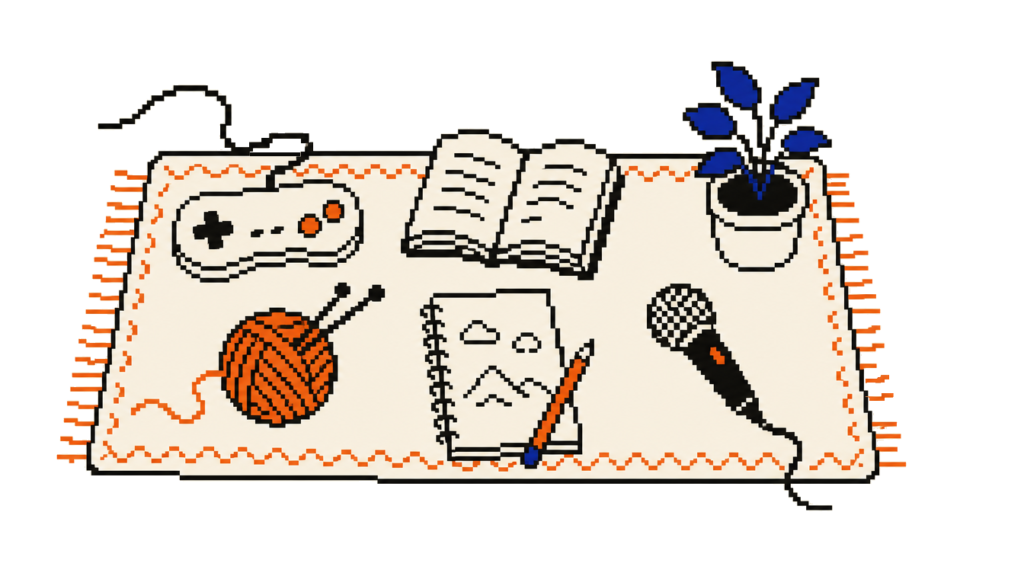
- A whole evening. A board game or a video game with someone in the same room. A long book in a reading corner (it can be as simple as one chair moved next to the window). A puzzle. A craft you have been meaning to try, like knitting or embroidery, where your hands are busy and your head gets quiet.
How to make the swap stick
The research in our last post points at the same few habits, and these are the ones that worked for me:
- Make the hobby easier to start than the phone. Shawn Achor calls this the “20-second rule”: he took his guitar out of the closet, put it on a stand in the middle of his living room, and then practiced every day for three weeks straight. I do not have an instrument at home anymore (I sold my guitar before I moved to Paris), but the idea works for anything: the book already waiting on the reading chair, the sketchbook open on the table, the console already plugged in.
- Decide when, ahead of time. “I will read more” rarely happens. “After dinner, I read in the chair by the window” usually does.
- Close the feed for the hour you chose. This is exactly what we built Tavla Block for: you schedule a block for the time you usually scroll, and the apps stay closed while you do the thing you picked.
- Write down what the time became. When a session ends, the app gives you a page to write what you did. After a few weeks you can read those notes back and see where your evenings actually went, like the songs you practiced and the chapters you finished, and that is a really nice thing to have.
A life with focus is mostly a life with hobbies
When people talk about focus, they usually mean work or studying: deep work, fewer distractions, better grades, more output. I care about that too, but the version I want for myself is bigger. I want to be able to focus on a song, a friend, a game, a book, the way I could when I was a kid and nobody had to tell me to. Getting that back has very little to do with productivity charts, and a lot to do with giving my evenings to things I actually chose.
If you have a hobby that pulled you out of the scroll, I would really love to hear about it. Write to me through the contact form on the home page, and if you are happy for me to, I might share some of them here.
Sources
- Csikszentmihalyi, M., & LeFevre, J. (1989). Optimal experience in work and leisure. Journal of Personality and Social Psychology, 56(5).
- Mak, H. W., Noguchi, T., Bone, J. K., et al., Fancourt, D. (2023). Hobby engagement and mental wellbeing among people aged 65 years and older in 16 countries. Nature Medicine, 29.
- Kaimal, G., Ray, K., & Muniz, J. (2016). Reduction of cortisol levels and participants’ responses following art making. Art Therapy, 33(2).
- Achor, S. (2010). The Happiness Advantage. Crown Business.